Hydrogen-compatible thread sealants from Loctite (Henkel)
With its Loctite brand, Henkel also offers solutions for the hydrogen industry, including hydrogen-compatible thread sealants and adhesives.
The main aim of Loctite hydrogen solutions is to prevent leaks, especially in high-pressure hydrogen environments, while a major advantage of Loctite hydrogen thread seals is that they meet the requirements of the “KIWA GASTEC QA AR 214” standard.
In the following article, we briefly discuss the importance of hydrogen as an energy source of the future, explain the areas in which Loctite products can be used for hydrogen systems, list the advantages of hydrogen-compatible Loctite products, explain the application of hydrogen-compatible Loctite thread sealants and present those Loctite products that are hydrogen-compatible according to the AR 214 standard and are suitable as thread sealants in hydrogen environments.
The importance of hydrogen as an energy source of the future
In industry, there is such and such hydrogen that is used. The future lies in so-called green hydrogen.
This is because the use of green and renewable hydrogen in the economy is one of five pillars for decarbonization as a measure against climate change, which could replace fossil fuels in many areas. The other four pillars are the expansion of renewable energies, direct electrification and the use of renewable heat, carbon capture and the implementation of energy efficiency measures.
However, handling hydrogen requires special technical challenges to be overcome.
Why use Loctite products for hydrogen systems?
Loctite has developed solutions for dealing with hydrogen in industry, such as adhesives, sealants and coatings, which will enable the hydrogen economy to grow faster. One of the main challenges is to increase safety in order to prevent hydrogen leaks.
Loctite’ s safe solutions ensure reliability along the hydrogen value chain, from hydrogen production, hydrogen storage, hydrogen transportation and hydrogen distribution to the end devices that consume the hydrogen. Specific areas of application include the following systems, devices and components:
- Hydrogen filling stations
- Electrolyzer systems
- Hydrogen generators
- Hydrogen gas burner
- Hydrogen storage systems
- Hydrogen pipelines
- Pipe connections
- Fuel cells
- Pressure sensors
- Measuring devices
- Compressors
- Valves
- Pumps
- Steam boiler
- Household appliances
Solutions for the hydrogen economy include Loctite thread sealants, which are used to prevent hydrogen leaks in pipe and hose connections where threads are present.
Other Loctite hydrogen solutions include liquid sealants to seal flange connections and hydrogen-compatible threadlockers designed for threaded parts that must withstand severe vibration and/or temperature fluctuations and prevent the threaded parts from loosening.
Advantages of hydrogen-compatible Loctite products
The advantages of Loctite hydrogen-compatible products include the following:
- Safety and reliability: Preventing hydrogen gas leaks ensures greater safety and improved reliability.
- Tested compatibility according to “KIWA GASTEC QA AR 214”: With the AR 214 standard, the Dutch certification institute KIWA is the only certification body to have developed an industry standard for hydrogen and specifically for hydrogen seals. If the “KIWA GASTEC QA AR 214” standard is met, admixtures of up to 100 % hydrogen gas are possible.
- Improved efficiency: Preventing leaks and loosening due to vibrations increases the overall efficiency of the system, reducing maintenance and downtime.
In an Henkel presents the advantages of the hydrogen-compatible Loctite products in an explanatory video. products.
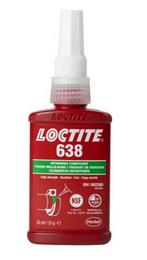
Application of the hydrogen-compatible thread sealant Loctite 638
Loctite 638 anaerobic thread sealant, also known as a joining adhesive, can be used to fill the air space between the threaded parts, whereby the Loctite sealant hardens to form a thermosetting plastic. This creates a
Thanks to Loctite’s hydrogen-compatible thread sealants, more expensive and complex sealing methods such as seal welding, cone fittings and threaded fittings can be dispensed with or minimized.
Hydrogen-compatible Loctite products according to AR 214 standard
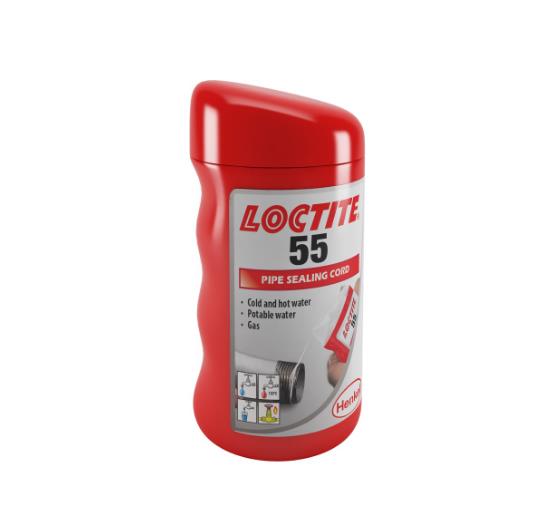
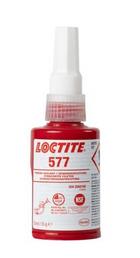
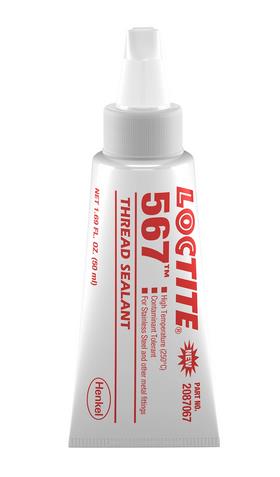
In addition to the hydrogen-compatible thread sealant Loctite 638, there are other Loctite products that are suitable as thread sealants and are hydrogen-compatible. In the following table, we have listed those Loctite products that are suitable as thread sealants for hydrogen gas mixtures with up to 100 percent hydrogen gas, i.e. they are hydrogen-compatible thread sealants and meet the requirements of the “KIWA GASTEC QA AR 214” standard:
| LOCTITE 55 | LOCTITE 567 | LOCTITE 577 | LOCTITE 570 | LOCTITE 638 | |
| Description | Thread sealant with immediate sealing effect against full pressure; reliable readjustment possible without leakage | Thread sealing paste with immediate sealing effect against low pressures; easy disassembly | Thread sealing paste with immediate sealing effect against low pressures; easy disassembly | Thread sealing paste with slow curing; low torque resistance for easy disassembly | Fast curing joining adhesive that is actually intended for bonding cylindrical parts to achieve high-strength bonded joints, but is also suitable for thread sealing and/or screw locking in connection with hydrogen applications with high pressure and/or extreme conditions |
| Pipe thread | Ideal for BSPT and NPT | Ideal for NPT | Ideal for BSPT and NPT | Ideal for BSPT and NPT | Ideal for BSPT and NPT |
| Curing | no | anaerobic | anaerobic | anaerobic | anaerobic |
| Standard | KIWA GASTEC QA AR 214 | KIWA GASTEC QA AR 214 | KIWA GASTEC QA AR 214 | KIWA GASTEC QA AR 214 | KIWA GASTEC QA AR 214 |
| Online store | Order here | Order here | Order here | Order here |
You may also be interested inthe following article: “Joining adhesives from Henkel – Loctite and Omnifit“
Henkel customer report on Loctite 638 adhesive
With regard to the use of Locitite 638 adhesive as a hydrogen-compatible thread sealant, Henkel reports the following success story or case study of a customer who operates a hydrogen filling station and was looking for a replacement product for PTFE tape to seal the threads, whereby this replacement had to withstand a pressure of up to 1,000 bar and a temperature range of -60 °C to 40 °C:
“A Henkel customer in the hydrogen refueling industry was struggling with leaks in its high-pressure systems. PTFE tape could not withstand extreme temperatures and pressure. He was recommended LOCTITE 638. The fast-curing, high-strength adhesive solved the problem and ensured that the filling stations remained leak-free and safe!”
Henkel customer report on Loctite 577 thread sealant
With regard to the hydrogen-compatible Locitite 577 thread sealant, Henkel also reports a success story or case study of a customer who used it to seal a hydrogen gas burner:
“A manufacturer of industrial equipment needed a thread sealant for its hydrogen gas burners that was suitable for various metals and high pressure. The solution? LOCTITE 577 thread sealant. It provides a reliable seal and withstands thermal and chemical stresses, ensuring leak-free performance.”
Here you can the hydrogen compatible thread sealant Loctite 577 in the online store of the Swiss Henkel distributor abovo.
You may also be interested inthe following articles:
Advice on hydrogen-compatible thread sealants from Loctite
We at abovo will be happy to advise you if you would like to use Loctite products in conjunction with hydrogen, especially as a thread sealant. Our Loctite hydrogen experts will help you select the right hydrogen-compatible Loctite product for your application.
Abovo has been an authorized distributor of Henkel Adhesive Technologies products for around 20 years; initially in the Henkel Electronics division and since 2022 also in the Henkel Industry division.
The best way to contact the Loctite hydrogen experts at abovo is by telephone or e-mail:
- Telephone number: +41 32 552 44 44
- E-mail: info@abovo.ch
If you decide to contact us by e-mail, we will reply as quickly as possible.