


Loctite 577 – Properties, Data Sheets, Applications, Buy
Loctite 577 is one of the world’s leading medium-strength thread sealants for securing and sealing pipe threads, fittings, and other metal threaded connections.
In the following article, drawing on our experience as Loctite experts, we explain the product properties of Loctite 577 in detail, provide links to download the relevant data sheets, explain how to use Loctite 577, and provide information on where to buy Loctite 577 in Switzerland.
THE MOST IMPORTANT THING IN BRIEF:
|
Overview

Loctite 577 – Product Features
First, we will provide a detailed overview of the product features of Loctite 577 thread sealant in several sections.
What is Loctite 577?
Loctite 577 is a medium-strength, thixotropic, single-component thread sealant designed to secure and seal pipe threads, fittings, and other metal threaded connections. Since it is an anaerobic thread sealant, it cures in the absence of air.
At low pressure, metal pipe connections achieve an immediate seal. With Loctite 577, there is no creep, shrinkage, or fraying. Applying the thread sealant is easy.
Loctite 577 is suitable for universal use, for example on active metals such as brass and copper, but also on passive metals such as stainless steel and aluminum. For this reason, Loctite 577 is also referred to as a universal thread sealant. Loctite 577 also offers excellent chemical resistance.
According to Henkel, minor surface contamination from cutting oils, lubricants, anti-corrosion oils, protective oils, or cleaners containing surfactants and corrosion inhibitors would not interfere with the curing of Loctite 577.
Übersicht technische Spezifikationen
Here is a table summarizing the technical specifications for Loctite 577 thread sealant:
- Area of application: universal
- Strength: medium
- Chemical basis: dimethacrylate ester
- Curing: anaerobic
- Secondary Curing: Activator
- Physical form: gel
- Color: yellow
- Fluorescence: yes, under UV light
- Viscosity, 20 RPM: 25,000.0 mPa·s
- Thixotropic: yes
- Operating temperature range: -55 to +180 °C
- Breakaway torque (steel, M10): 33.0 N·m (295.0 in./lb.)
- Thread size: up to M80/R3″
- Chemical resistance: excellent
- Storage (unopened container): dry place, 8 °C to 21 °C
- Shelf Life of Loctite 577: 730 days
- Shipping: at room temperature (not frozen)
- DVGW approval (EN 751-1); KIWA gas certification in accordance with GASTEC QA approval requirements 31-1; oxygen certification in accordance with BAM
- Registered in the NSF category S2
- Drinking Water Certification for Applications Using Loctite SF 7649 Activator in Accordance with WRAS (BS6920-1)
Loctite 577 Temperature
The operating temperature range for Loctite 577 is -55 to +180 °C.
Loctite 577 Plastic Compatibility
According to Henkel, Loctite 577 is not recommended for use on plastics; this applies in particular to thermoplastic materials, as stress cracks can form in them. Henkel recommends that users first test the compatibility of Loctite 577 with the plastic.
Hazard Warnings
The manufacturer, Henkel, provides the following hazard warnings for Loctite 577:
- H317 Kann allergische Hautreaktionen verursachen
- H412 Schädlich für Wasserorganismen, mit langfristiger Wirkung
Safety Instructions
The manufacturer, Henkel, provides the following safety instructions for Loctite 577:
- For private consumers only:
- P101 If medical advice is needed, have the container or label on hand
- P102 Keep out of reach of children
- P501 Dispose of contents/container in accordance with national regulations.
- P273 Avoid release into the environment
- P280 Wear protective gloves
- P333+P313 If skin irritation or rash occurs: Get medical advice/attention
Comparison Tables
In the comparison tables below, you can compare the various Loctite thread sealants with one another—for example, Loctite 577 vs. 5776:
Source: Henkel – Loctite, Bonderite, Technomelt, Teroson, Product Catalog: Adhesives, Sealants, and Surface Technology for Industry, Edition 3.2
Source: Henkel – Loctite, Bonderite, Technomelt, Teroson, Product Catalog: Adhesives, Sealants, and Surface Technology for Industry, Edition 3.2
Be sure to check out our article“Loctite Thread Sealants from Henkel.”
Loctite 577 Data Sheets
Are you looking for the Loctite 577 data sheet in German? The manufacturer, Henkel, provides not only a data sheet for Loctite 577, but also various other documents, including a safety data sheet, a technical data sheet, and a regulatory data sheet. In the sections below, we have compiled links to the most important data sheets for Loctite 577.
Loctite 577 Safety Data Sheet
The Loctite 577 Safety Data Sheet (SDS) is intended primarily for occupational safety. This Safety Data Sheet contains, among other things, information on potential hazards, the product’s chemical composition, first aid measures, firefighting measures, measures to address accidental release, handling, storage, physical and chemical properties, stability and reactivity, human and environmental toxicology, and disposal instructions.
You can download the Loctite 577 (50 ml) safety data sheet here.
You can download the safety data sheet for Loctite 577 (250 ml) here.
Loctite 577 Technical Data Sheet
The Loctite 577 technical data sheet lists, among other things, the product’s physical properties, specifies cure times for various materials and other factors, and provides instructions for use and application guidelines.You can download the Loctite 577 technical data sheet here.
Loctite 577 Regulatory Data Sheet
The regulatory data sheet for Loctite 577 lists prohibitions and restrictions, the inventory status, and substances of concern.
You can download the regulatory data sheet for Loctite 577 (50 ml) here.
You can download the regulatory data sheet for Loctite 577 (250 ml) here.
Loctite 577 RoHS
The document “Loctite 577 RoHS” indicates whether the product complies with the RoHS Directive, according to the manufacturer Henkel. RoHS stands for “EU Directive 2011/65/EU on the restriction of the use of certain hazardous substances in electrical and electronic equipment”; in German: “Directive 2011/65/EU of the European Parliament and of the Council of June 8, 2011, on the restriction of the use of certain hazardous substances in electrical and electronic equipment.”
Here you can purchase Loctite 577 (50 ml) RoHS here.
Here you can purchase Loctite 577 (250 ml) RoHS here.
Loctite 577 Application
When using Loctite 577, you should follow the manufacturer’s instructions. The Henkel website provides the following information regarding the use of Loctite 577 thread sealant:
Apply Loctite 577
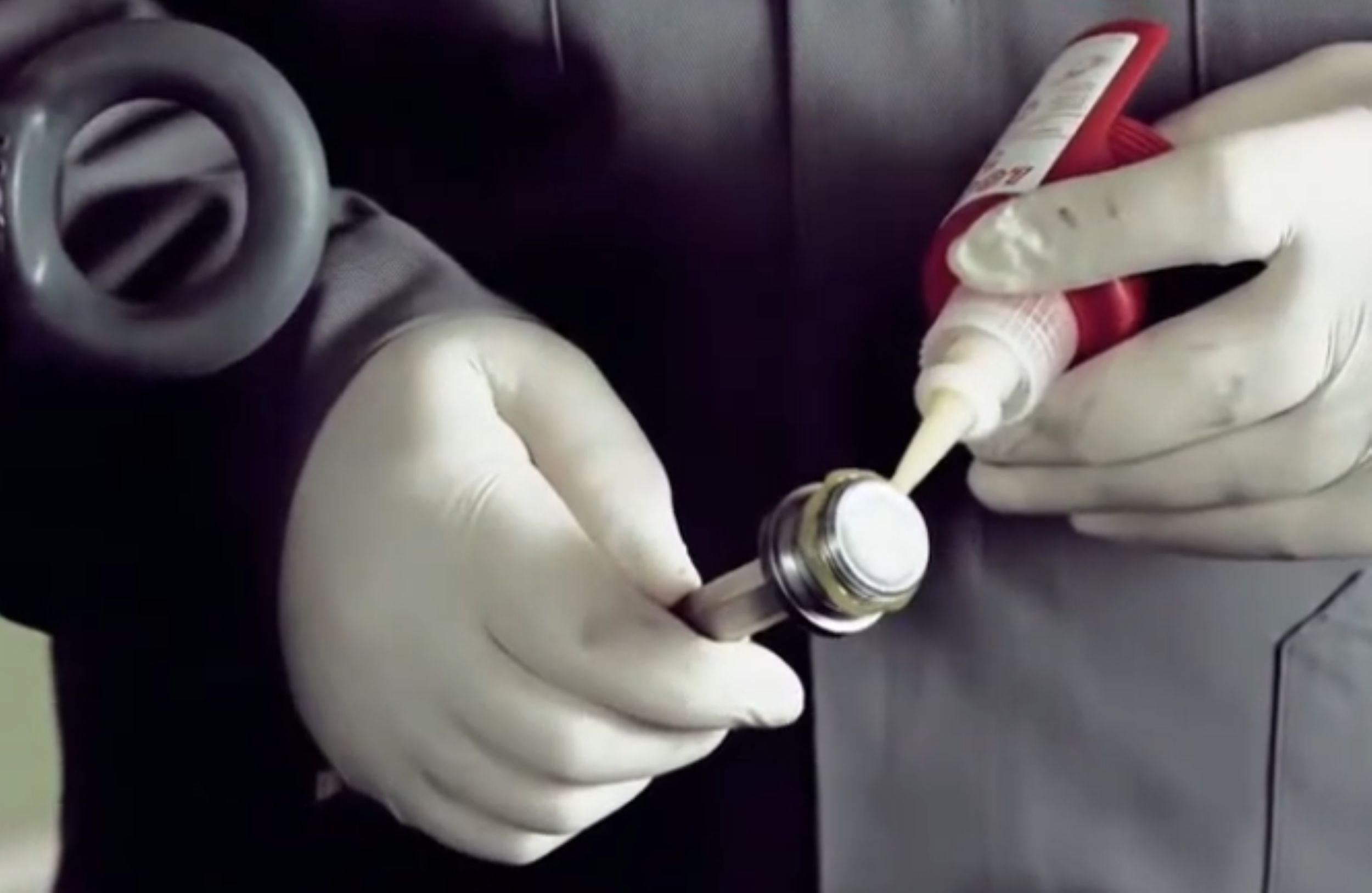
When applying Loctite 577 thread sealant by hand, Henkel recommends using a hand-operated peristaltic pumpto ensure a consistent flow of the product.
When applying Loctite 577 thread sealant, follow these steps:
1. Clean the surfaces to be sealed with a Loctite cleaner, such as Loctite SF 7063 or Loctite SF 7064.
2. If necessary, use an activator to increase the curing speed—for example, Loctite SF 7240 or Loctite SF 7649—such as when working with passive metals (stainless steel, aluminum) or at low temperatures (below 5 °C).
3. Apply Loctite 577 in a 360° ring around the start of the external thread. Leave the first thread pitch free. If the thread is larger, apply the product to both the external and internal threads.
4. The pipe thread can now be screwed in place, and the connection can be tightened using a pipe wrench in accordance with the manufacturer’s recommendations.
Removing Loctite 577
To loosen Loctite 577—that is, to disassemble it— standard hand tools are usually sufficient.
If you are unable to remove Loctite 577 using standard hand tools, you can heat the area to approximately 250 °C. Disassembly must then be performed while the area is still warm.
In the case of corroded or seized parts, Henkel recommends using Loctite LB 8040 Freeze & Release before disassembly..
Buy Loctite 577 in Switzerland
In Switzerland, for example , you can buy Loctite 577 from the online store of abovo , the Swiss Henkel distributor . The following package sizes of Loctite 577 thread sealant are available from abovo and can be purchased individually:
Click here to go to the Loctite 577 product page in the abovo online store.
Advice on Loctite 577
If you have any questions about Loctite 577 thread sealant, we at abovo, a Henkel distributor, will be happy to answer them. Of course, we’re also here to provide you with information and advice on all other Henkel products from the Henkel Adhesive Technologies division.
abovo AG, based in Selzach, Switzerland, has been an authorized distributor of Henkel Adhesive Technologies products for about 20 years; initially in the Henkel Electronics division and, since 2022, also in the Henkel Industry division.
The best way to contact the Henkel experts at abovo is by telephone or e-mail:
- Telephone : +41 32 552 44 44
- E-mail: info@abovo.ch
If you contact us by e-mail, we will reply as quickly as possible.