


Good to Know | ESD
Loctite 577 – Properties, Data Sheets, Applications, Buy
Loctite 577 is one of the world’s leading medium-strength thread sealants for securing and sealing pipe threads, fittings, and other metal threaded connections. In the following article, drawing on our experience as Loctite experts, we explain the product properties of Loctite 577 in detail, provide links to download the relevant data sheets, explain how to […] Learn more


Importance of ESD flooring and ESD footwear for electronics production
ESD floors and ESD shoes are particularly important in the production of electrostatically sensitive electronic components in order to prevent damage caused by uncontrolled discharges. They dissipate electrostatic charges in a controlled manner. In this way, employees can be grounded in an ESD protection zone.
Learn more
Dangers of ESD in the cleanroom and possible solutions
The topic of ESD in cleanrooms should not be neglected, as electrostatic charges and discharges can occur in cleanrooms. This poses a particular risk, especially in cleanrooms in which electrostatically sensitive components are produced, assembled or otherwise processed. ESD-compatible cleanrooms are therefore required in the electronics and microelectronics industries, among others.
Learn more
ESD control program: creation, establishment and maintenance
An ESD control program to prevent damage to sensitive components from electrostatic discharge begins with design, followed by creation and then setup. Once established, the ESD control program must be maintained. In the following, we will discuss the individual requirements for an ESD control program plan. What is an ESD control program? An ESD control […]
Learn more
50 years of ESD – the history of electrostatic discharge control
The history of controlling electrostatic discharges in the electrical industry is just half a century old – but the phenomenon of electrostatics has been observed since ancient times. Electrostatic phenomena noticed early on The ancient Greeks observed as early as 550 BC that amber can be electrostatically charged through friction. It is not without reason […]
Learn more
Customize ESD workbench with 3D configurator from Treston
ESD workbenches from Treston, complete ESD workstations or ESD workbenches with ESD laminate can be customized with the 3D workstation configurator from Treston. 3D workstation configurator from Treston Treston offers the 3D configurator for the individual design of a Treston workbench or workstation via the Internet as a web application. We will explain below how […]
Learn more
ESD for electric cars – will every garage soon have an ESD workstation?
In view of the increasing spread of electric vehicles, the question arises as to whether every garage that offers repairs and service for electric cars also needs an ESD workstation. In the following article, we look at ESD protection in the field of e-mobility and the personal protective equipment (PPE) required in view of the […]
Learn more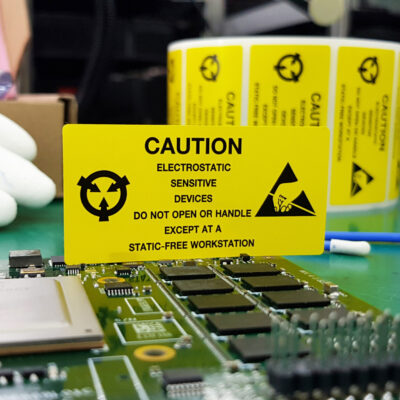
ESD table mat – made to measure at abovo
You can also order made-to-measure ESD table mats online from ESD specialist wholesaler abovo. The range includes a two-layer ESD table mat with a typical discharge resistance.
Learn more
ESD flooring – material, installation, marking and earthing
If you want to set up an ESD protection area or an ESD protection zone (EPA), you should ideally also lay an ESD floor covering that serves in particular to ground the people working in the EPA. This article explains which material is best suited for an ESD floor covering and how the floor covering should be laid, marked and earthed.
Learn more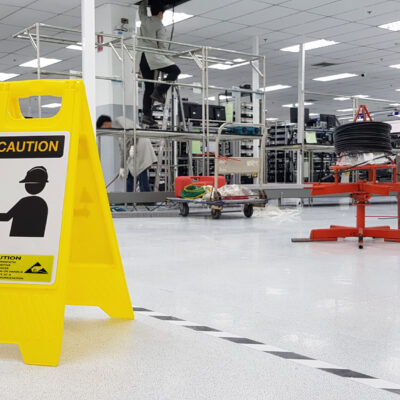
What measures are there for earthing people?
To protect electrostatically sensitive components (ESDS), employees, visitors and supervisors who come into contact with these components must be earthed. Certain measures must be taken to ensure that personal earthing is effective. This article explains what these are and the easiest way to ground people.
Learn more
ESD rules of conduct and ESD checklist
Certain rules of conduct must be observed in an ESD protection zone to prevent electrostatic discharge from damaging ESD-sensitive electronic components in particular. You can read about these rules in the following article.
Learn more